Sailgene Technology

Beyond SNPs: Why Structural Variants Are Reshaping Crop Breeding
Release time:2026-07-30 09:46:55
As crop breeding enters the era of pangenomes and telomere-to-telomere (T2T) sequencing, structural variants are emerging as one of the most important underexplored sources of genetic variation.
Are We Looking at the Right Variants?
For decades, single nucleotide polymorphisms (SNPs) have been the cornerstone of crop genetics. They are abundant, relatively easy to detect with short-read sequencing, and have powered countless genome-wide association studies (GWAS), marker-assisted selection, and genomic prediction models.
But as researchers continue to sequence more crop genomes, an important question is emerging: Can SNPs alone explain complex agronomic traits?
Increasingly, researchers recognize that SNPs alone cannot capture the full spectrum of genetic variation underlying complex traits.
A growing body of evidence suggests that many economically important traits, which include disease resistance, flowering time, environmental adaptation, and grain quality. They are strongly influenced by structural variants (SVs), a class of genomic variation that has long been underestimated due to technical limitations.
Structural Variants: Small in Number, Big in Impact
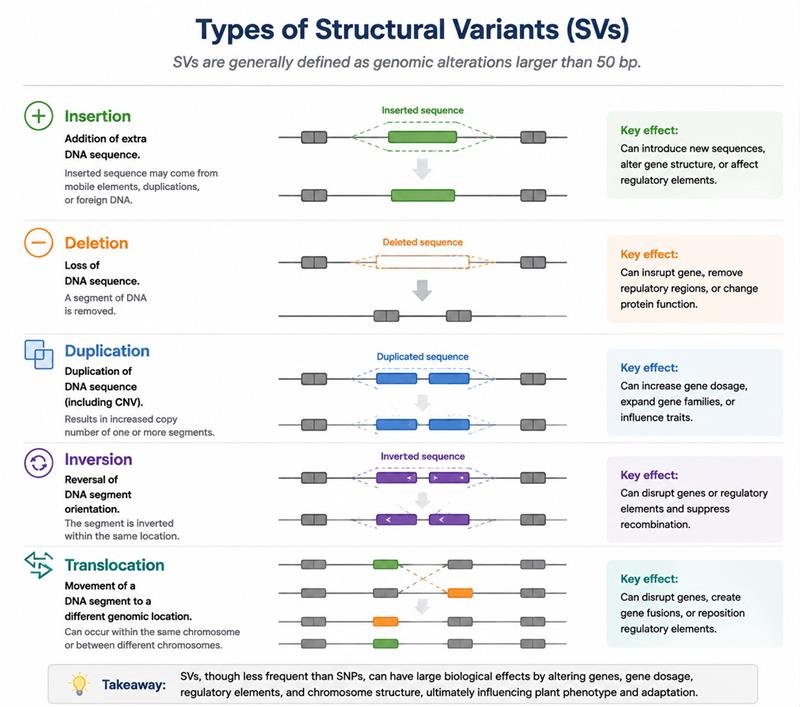
Unlike SNPs, which alter a single DNA base, structural variants generally are genomic changes larger than 50 base pairs, including insertions, deletions, duplications, inversions, and translocations.
Although they are less frequent than SNPs, their biological impact is often much greater. A single structural variant can:
- Delete ordisrupt an entire functional gene
- Duplicate disease-resistance gene clusters
- Alter regulatory elements controlling gene expression and promoter activity
- Rearrange chromosome structure and suppress local recombination
- Create presence/absence variation (PAV) between crop cultivars and wild relatives
- Alter gene dosage
- Change regulatory landscopes
Because of these effects, SVs can dramatically influence plant phenotype without changing a single nucleotide within a coding sequence.
Real-World Impact: SVs Drive Critical Agronomic Traits
Across multiple crop species, researchers have linked SVs to critical agronomic performance:
- Disease Resistance: Expansion or loss of Nucleotide-binding leucine-rich repeat (NLR) proteins/receptors gene clusters via tandem duplication and deletion.
- Flowering Time and Photoperiod: SVs in promoter /regulatory regions driving altered developmental timing
- Grain and Fruit Quality: Copy number variation (CNV) directly modulating metabolic pathways and seed composition
- Abiotic Stress Tolerance: Large structural insertions enabling enhanced drought, salinity, and cold adaptation
- Yield-Related Traits: Structural rearrangements modifying architecture genes and nutrient allocation
These findings suggest that two crop varieties may share highly similar SNP profiles while differing substantially in structural variation, and therefore in phenotype.
For breeding programs aiming to improve complex traits, overlooking SVs means overlooking a vast reservoir of functional diversity.
Why Have Structural Variants Been Difficult to Study?
The challenge has never been that structural variants are rare. It has been detecting them accurately.
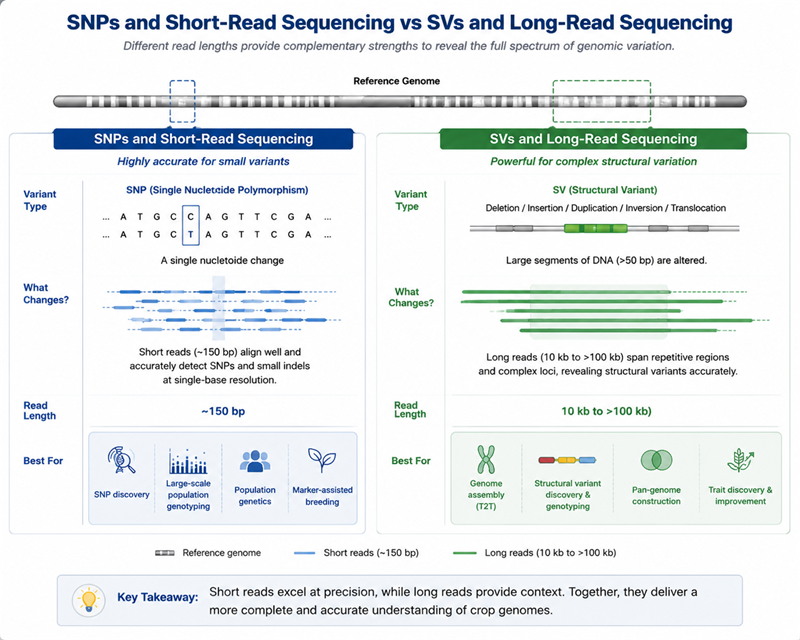
Short-read sequencing can detect some SVs, but its limited read length (~150 bp) often prevents accurate resolution of complex structural rearrangements. Large insertions, inversions, tandem repeats, and transposable elements (TEs) often span thousands of base pairs, extending far beyond short reads.
These limitations become severe in complex plant genomes characterized by:
- Highly repetitive DNA content and transposable elements
- Polyploid genomes (e.g., wheat, sugarcane, cotton)
- Extensive segmental duplications
- Deeply diverged haplotypes
This is one reason why structural variation remained underexplored for many years.
Long-Read Technologies and T2T Assemblies Are Changing the Game
Complementary strengths of PacBio HiFi long reads and Oxford Nanopore Technologies (ONT) Ultra-long sequencing, combined with Hi-C scaffolding, have revolutionised plant genomics.
Instead of piecing together fragments, long reads span complex loci directly, enabling researchers to create near-complete or T2T assemblies and graph-based pangenomes.
Long-read sequencing empowers crop genetics to:
- Uncover Hidden SVs and PAVs: Detect large insertions, deletions, and complex structural rearrangements with ultra-high resolution.
- Achieve Haplotype Phasing: Resolve allele-specific variation across heterozygous and polyploid genomes.
- Construct Graph Pangenomes: Move beyond a single linear reference genome to capture species-wide structural diversity.
- Map Repetitive & Heterochromatic Regions:Fully resolve centromeric, telomeric, and complex NLR gene regions.
As long-read sequencing becomes more accessible, structural variant analysis is shifting from a specialised application to a routine component of modern crop genomics.
Research Spotlight: Long Reads Uncover Hidden Crop Diversity
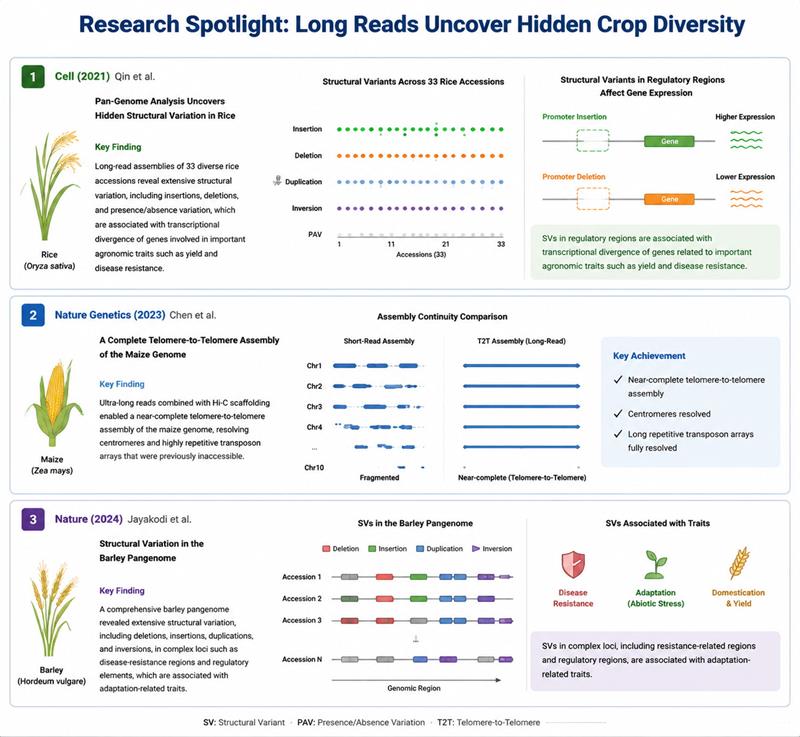
1.Cell (2021): Pan-Genome Analysis Uncovers Hidden Structural Variation in Rice
Key Finding: High-quality long-read assemblies from 33 genetically diverse rice accessions enabled the construction of an extensive structural variation catalogue. Analyses demonstrate that structural variants, including promoter insertions and deletions, shape transcriptional divergence for critical genes associated with grain yield and disease resistance.
- Literature Link: Qin, P. et al. Pan-genome analysis of 33 genetically diverse rice accessions reveals hidden genomic variations. Cell 3542-3558. e16 (2021)
- DOI: https://doi.org/10.1016/j.cell.2021.04.046
2.Nature Genetics (2023): A Complete Telomere-to-Telomere Assembly of the Maize Genome
Key Finding:
Key Finding: Utilising ultra-long read sequencing, researchers generated a gapless T2T assembly of the maize Mo17 genome. This work resolves challenging genomic regions including centromeres and highly repetitive transposon arrays, which remain inaccessible with short-read sequencing and earlier fragmented reference assemblies.
- Literature Link: Chen, J. et al. A complete telomere-to-telomere assembly of the maize genome. Nature Genetics 55, 1221–1231 (2023)
- DOI: https://doi.org/10.1038/s41588-023-01419-6
3.Nature (2024): Structural Variation in the Barley Pangenome
Key Finding: Constructed a high-resolution pangenome of wild and domesticated barley (Hordeum vulgare). By leveraging long-read sequencing, researchers catalogued widespread structural variation and copy number variations across diverse germplasms. Functional investigation revealed that structural variants within structurally complex loci, including resistance gene clusters and cis-regulatory regions, were associated with traits related to domestication, adaptation, and resistance-related loci.
- Literature Link: Jayakodi, M. et al. Structural variation in the pangenome of wild and domesticated barley. Nature 636, 654–662 (2024)
- DOI: https://doi.org/10.1038/s41586-024-08187-1
Graph-Based Pangenome & SV Analysis Platform
To translate complex structural variation into actionable breeding insights, Sailgene offers its Graph-Based Pangenome, telomere-to-telomere sequencing and SV Analysis Solution.
Unlike conventional approaches that align sequences to a single linear reference genome, which often miss non-reference sequences, our graph platform is able to construct a unified, species-wide pangenome graph that accurately captures a broad spectrum of structural variants, insertions, and deletions across diverse germplasms. Besides, T2T genome assembly enables chromosome-level resolution of complete genomic regions from telomere to telomere.
Key Capabilities of the Sailgene Pangenome Platform:
- Comprehensive Graph Construction: Merges dozens to hundreds of long-read assembled genomes (PacBio HiFi / Nanopore Ultra-long) into a multi-haplotype graph genome.
- High-Precision SV and PAV Cataloguing: High-resolution detection of Presence/Absence Variations (PAVs), Copy Number Variations (CNVs), inversions, and complex translocations across the entire population.
- Haplotype-Resolved Mapping: Complete phasing of complex heterozygous or polyploid alleles, isolating specific disease resistance or yield-enhancing haplotypes.
- Downstream SV-GWAS and Genotyping Pipelines: Enables direct association mapping between large structural variants and key agronomic traits, bypassing the limitations of SNP-only GWAS.
Understanding structural variation is no longer a technical bottleneck—it is an essential step toward developing the next generation of climate-resilient, high-yield crop varieties.
Looking Beyond SNPs
As crop breeding moves toward pangenome analysis and precision genomics, researchers are beginning to ask different questions.
Instead of asking:
"Which SNP is associated with this trait?"
Many studies now ask:
"What genomic structure controls this trait?"
Answering that question requires sequencing technologies capable of resolving complex genomic regions—not just detecting small sequence changes.
At Sailgene, we support crop genomics research through integrated long-read sequencing, genome assembly, structural variant analysis, and bioinformatics solutions. By combining advanced sequencing technologies with downstream analysis, we help researchers uncover genomic variation that may remain hidden using conventional approaches.
Understanding structural variation is no longer simply a technical challenge—it is becoming an essential step toward developing the next generation of resilient, high-yield crop varieties.
Previous Page
Previous Page

Contact Us
If you are interested in our long-read sequencing services or potential collaboration, please contact us. Our team is ready to support your research with tailored solutions. We also welcome feedback from users to help us improve our services.

Contact Us
Add: One Innovation Drive, Suite B3-406, Worcester, MA 01605, USA
在线客服添加返回顶部
右侧在线客服样式 1,2,3 1
图片alt标题设置: SAILGENE TECHNOLOGY INC.
表单验证提示文本: Content cannot be empty!
循环体没有内容时: Sorry,no matching items were found.
CSS / JS 文件放置地